Their Story
The Virgin of Candelaria emerged not as a documented historical figure, but as a profound spiritual encounter—a mystery itself. On the islands of Tenerife, isolated communities faced profound spiritual loneliness, cultural displacement, and the fear that their faith might be forgotten in a world that seemed indifferent to their struggles. They carried the weight of distance, of separation from spiritual centers, of wondering whether divine love could reach them in their remote corner of existence.
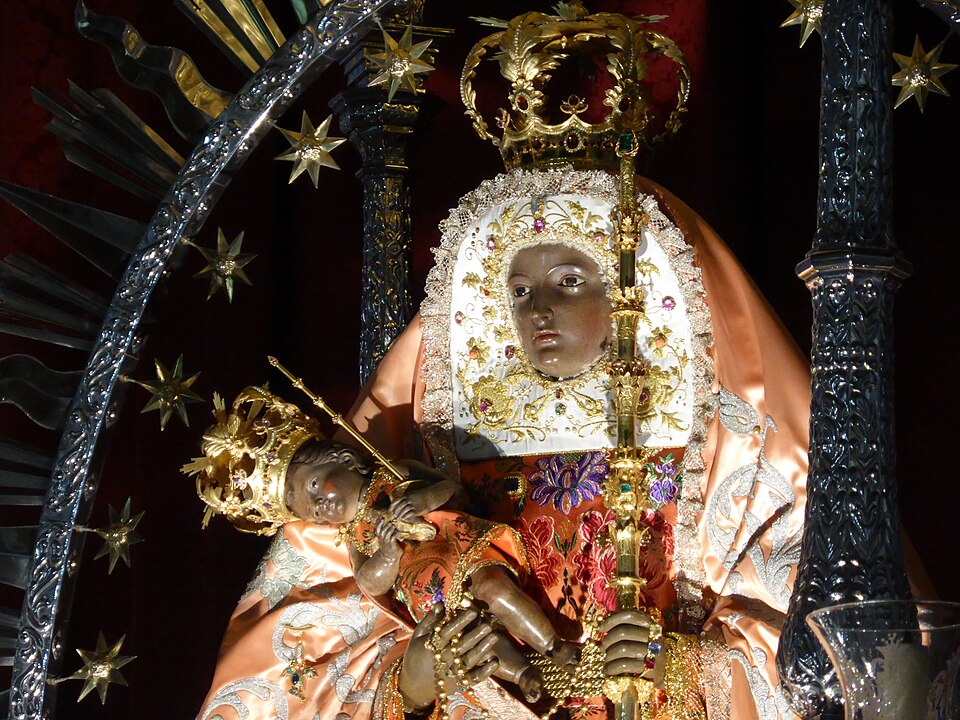
Then came the apparition: a Black Madonna, dark-skinned like the people she came to serve, holding a candle in one hand and a child in the other. She didn't arrive with fanfare or theological explanations. She came as a mother appears to a lost child—quietly, intimately, undeniably present. Her image held a radical message: that holiness doesn't require whitewashing, that the divine sees you in your own cultural skin, that even in isolation, you are held.
What transformed the Canary Islands and spread her devotion across continents was this: a people recognizing themselves reflected in the sacred. The Virgin of Candelaria became proof that God's love transcends geography, that spiritual comfort arrives when institutional religion feels distant, and that maternal compassion knows no boundaries. Her candle became a symbol of illumination piercing darkness—not erasing it, but showing the way through.
Why People Pray to Virgin of Candelaria
In an era of spiritual fragmentation and cultural displacement, people turn to the Virgin of Candelaria for reassurance that they belong. Those feeling invisible in religious institutions find solace in her dark features—she sees them fully. Parents invoke her protection; communities facing isolation or marginalization seek her intercession. Her candle represents hope when circumstances feel impossibly dark. She embodies the truth that divine presence meets us where we are, not where institutions expect us to be.
Patron Saint Of
Lasting Impact
The Virgin of Candelaria transformed from a localized apparition into a global spiritual anchor spanning five continents. Her basilica in Tenerife stands as testimony to grassroots faith, while her patronage extends from Bolivia to the Philippines. She remains the living proof that spiritual authenticity transcends borders, that cultural particularity strengthens rather than limits holiness, and that a single image of tender maternal presence can heal communities across centuries.
Where Venerated
- honor of the Virgin during the month of August are a syncretized reminiscence of the ancient feasts of the Beñesmen
- the Canary Islands