Their Story
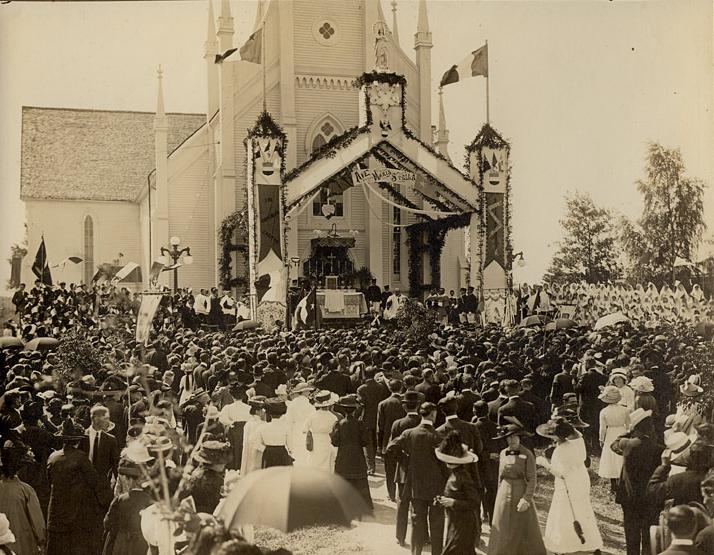
The Acadians faced an impossible question: disappear into the larger French-Canadian identity, or risk invisibility by standing alone? After over a century of persecution, displacement, and cultural erosion—the Great Expulsion still fresh in collective memory—Acadian leaders gathered at Memramcook in 1881, deeply uncertain whether their fragile culture could survive another generation.
The debate was brutal and intimate. Some argued for June 24, Saint-Jean-Baptiste Day, the established French-Canadian celebration. Unity meant survival, they reasoned. Safety in numbers. But others—traditionalists led by Abbot Marcel-François Richard—carried a different conviction: a people who preserved their faith, language, and autonomy through persecution deserved to affirm their own existence. They had endured too much to become footnotes in someone else's story.
The choice of August 15—Assumption Day, honoring Mary as the Acadians' patron saint—was an act of spiritual defiance. It wasn't easier (harvest season made gathering difficult). It was harder. But it was theirs. Within three years, they adopted their own flag. They had chosen vulnerability and distinctiveness over the comfort of belonging to something larger. This wasn't pride; it was resurrection. A people saying: we survived annihilation. We deserve to celebrate ourselves.
Why People Pray to National Acadian Day
People turn to National Acadian Day when facing the tension between belonging and authenticity, between assimilation and identity. In our globalized age of homogenization, the Acadian witness speaks powerfully to minorities, immigrants, and marginalized communities wrestling with whether they can preserve what makes them distinct without isolation. The feast invites us to honor our particular stories—not as divisive, but as sacred.
Patron Saint Of
Lasting Impact
National Acadian Day transformed a traumatized diaspora into a resilient people. By choosing a feast day rooted in Marian devotion and cultural specificity, Acadians modeled how communities can honor their past, reclaim agency, and celebrate identity without rejecting broader solidarity. The tintamarre—their joyful, boisterous celebration—remains a defiant song of survival.