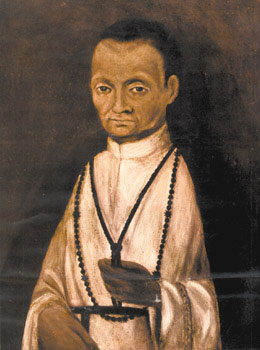
Their Story
Martin arrived in Lima in 1579 as a child of shame—born to a Spanish nobleman and an enslaved Black woman, he occupied a precarious space between worlds. His own father rejected him. Society dismissed him as illegitimate and inferior. The Dominican monastery that became his refuge initially assigned him the lowest tasks: sweeping, cleaning, hauling water. For decades, no one asked his name. He had no formal education, no status, no voice in the community that sheltered him.
Yet Martin never hardened into bitterness. Instead, he made his invisibility sacred. While others slept, he prayed. While others ignored the dying plague victims in Lima's streets, Martin ventured into infected quarters with bandages and herbs. He cared for enslaved people with the same tenderness he showed the wealthy. Miracles followed—not because Martin sought glory, but because his love had become so radical it seemed to bend reality itself. A dog, cat, bird, and mouse eating from one bowl became his symbol—enemies made kin through compassion.
By his sixties, the monastery recognized what the poor had always known: Martin was extraordinary. Not despite his marginalization, but through it. His struggle with rejection became his greatest strength. He understood suffering intimately. When he died in 1639, thousands mourned. The Church eventually canonized the "Saint of the Broom," declaring that the outsider society had nearly broken was actually unbreakable.
Why People Pray to Martin de Porres
People seek Martin de Porres when they feel unseen, rejected, or trapped between identities. He is the patron of racial justice, social workers, healers, and anyone fighting for dignity in systems that diminish them. In our fractured world, Martin intercedes for mixed-race people, for those experiencing discrimination, for public health workers, and for anyone who has been told they don't belong. His story whispers: your pain has purpose; your rejection can become your redemption.
Patron Saint Of
Lasting Impact
Martin de Porres shattered the assumption that holiness requires privilege. He proved that the lowliest servant can become the most essential saint. His canonization in 1962 was prophetic—a declaration that the voiceless matter, that the marginalized carry divine light, and that radical love is the only revolution that endures. He remains the patron of those building just societies.