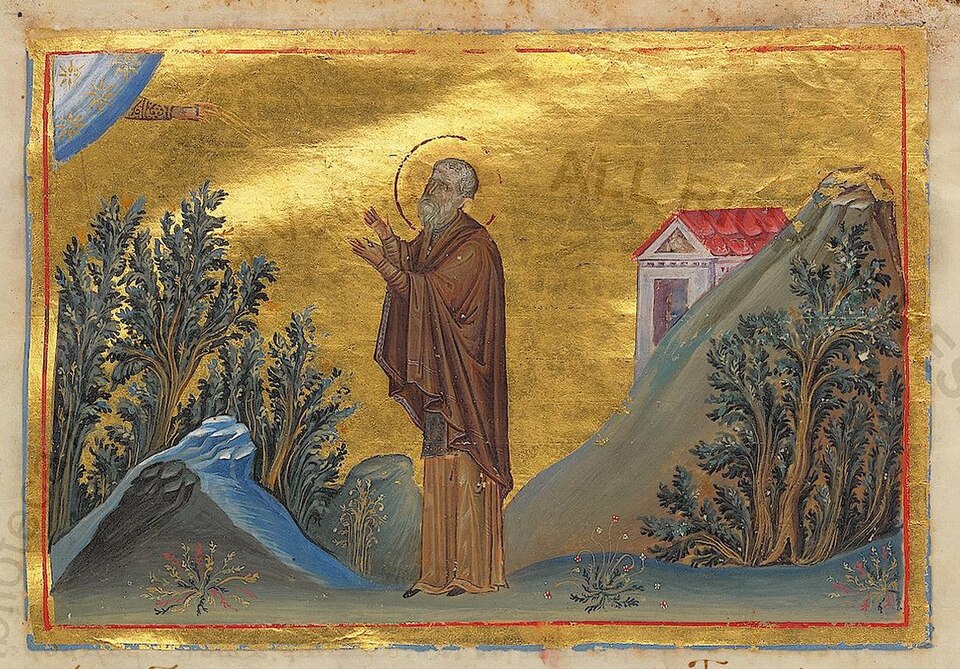
Their Story
Joannicius began as everything the church feared: a robust military officer in the Byzantine army, riding with emperors, defending imperial power. By all accounts, he was good at violence. Strong. Fearless. But he carried a poison in his chest—he had become a persecutor of sacred images, swept up in the iconoclastic fury of his era. At forty, something fractured. A chance encounter with a holy monk during the reign of Empress Irene cracked open his conscience. He didn't become a saint overnight. Instead, for six years, he wept. While still in uniform, he fasted and prayed in secret, torn between two worlds. The emotional weight of his transformation was so intense that at forty, he finally fled—abandoning the only life he'd known to climb Mount Olympus in Bithynia.
On that mountain, Joannicius learned to read like a child. He memorized the entire psalter. He spent twelve years in complete solitude, wrestling with himself in the silence. Gradually, the soldier's rigid discipline transformed into something luminous: the gift of prophecy, the ability to see into human hearts, the wisdom to guide others toward healing. His prayers became so continuous that he developed what he called "the seasoning of the heart"—a constant conversation with the divine that flavored every moment.
By old age, Joannicius had become the most respected voice in Christendom. When Emperor Theophilus persecuted icon veneration, Joannicius stood unshakeable in his visions and prophecies. Years later, when Empress Theodora restored the sacred images to churches, many attributed this victory directly to his spiritual influence. The violent persecutor had become the church's prophetic conscience. He died at eighty-four, having lived longer than most men of his time, and transformed completely.
Why People Pray to Joannicius the Great
People turn to Joannicius when trapped in old patterns of violence, anger, or ideology. His life proves that no past is too damaged, no heart too hardened for radical transformation. Those battling shame about their former selves—who they were before awakening—find in him a mirror and a map. He intercedes for those caught between worldly power and spiritual truth, for military personnel seeking redemption, and for anyone convinced their flaws disqualify them from holiness.
Lasting Impact
Joannicius reshaped Orthodox theology by proving that asceticism and prophecy are not escapes from the world but medicine for it. His defense of icon veneration during persecution became foundational doctrine for Eastern Christianity. Most profoundly, he established the archetype of the transformed warrior-mystic: the man who proves that violent pasts need not define eternal futures. His feast day (November 4) remains a reminder that radical change is possible at any age.