Their Story
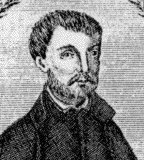
Stephen Pongracz was born into privilege in Alvincz Castle, a Transylvanian nobleman's son who seemed destined for comfort. But something deeper called him. Around 1602, he abandoned his birthright and entered the Society of Jesus—a choice that confused his family and left him vulnerable in a world that valued titles and power. For years, he studied in Bohemia and Austria, working quietly as a priest in small towns, seemingly unremarkable. He was not a famous theologian. He was not a celebrated preacher. He was simply a man trying to serve faithfully in an age of religious upheaval and political chaos.
But on September 5, 1619, everything changed. A Calvinist army under Gabriel Bethlen swept into Kassa (modern-day Košice). Stephen and his fellow Jesuit Melchior Grodziecki, along with diocesan priest Marko Krizin, found themselves trapped. The soldiers came before dawn on September 7, weapons drawn, demanding one thing: renounce your faith. Accept Calvinism. Save your life.
Stephen faced the choice that defines a martyr—not in theory, but in terror and blood. He refused. All three priests refused. They were tortured, their bodies broken for daring to say no. In that moment of agony, Stephen became not a quiet servant but a witness to something eternal. His death was not an accident of history; it was a declaration that some truths matter more than breathing. He was canonized in 1995, nearly 400 years later, when Pope John Paul II lifted him from beatified saint to full canonization—a recognition that his sacrifice still speaks.
Why People Pray to Stephen Pongracz
Stephen Pongracz is invoked by those facing impossible choices between faith and survival, between conscience and compromise. In our age of quiet apostasy—where pressure to abandon conviction is often subtle rather than violent—Stephen reminds us that integrity has a cost, and that cost is worth paying. People pray to him when they're tempted to minimize their beliefs for acceptance, career advancement, or safety. He intercedes for the persecuted, for prisoners of conscience, and for anyone who must choose between the world's demands and their deepest convictions.
Lasting Impact
Stephen Pongracz's martyrdom became a rallying point for Hungarian Catholicism during centuries of religious conflict. His shrine in Košice remains a pilgrimage destination where the faithful encounter a saint who shows that faithfulness is measured not by comfort or success, but by unwavering witness to truth. He stands as a bridge between the early Christian martyrs and modern believers facing their own tests.