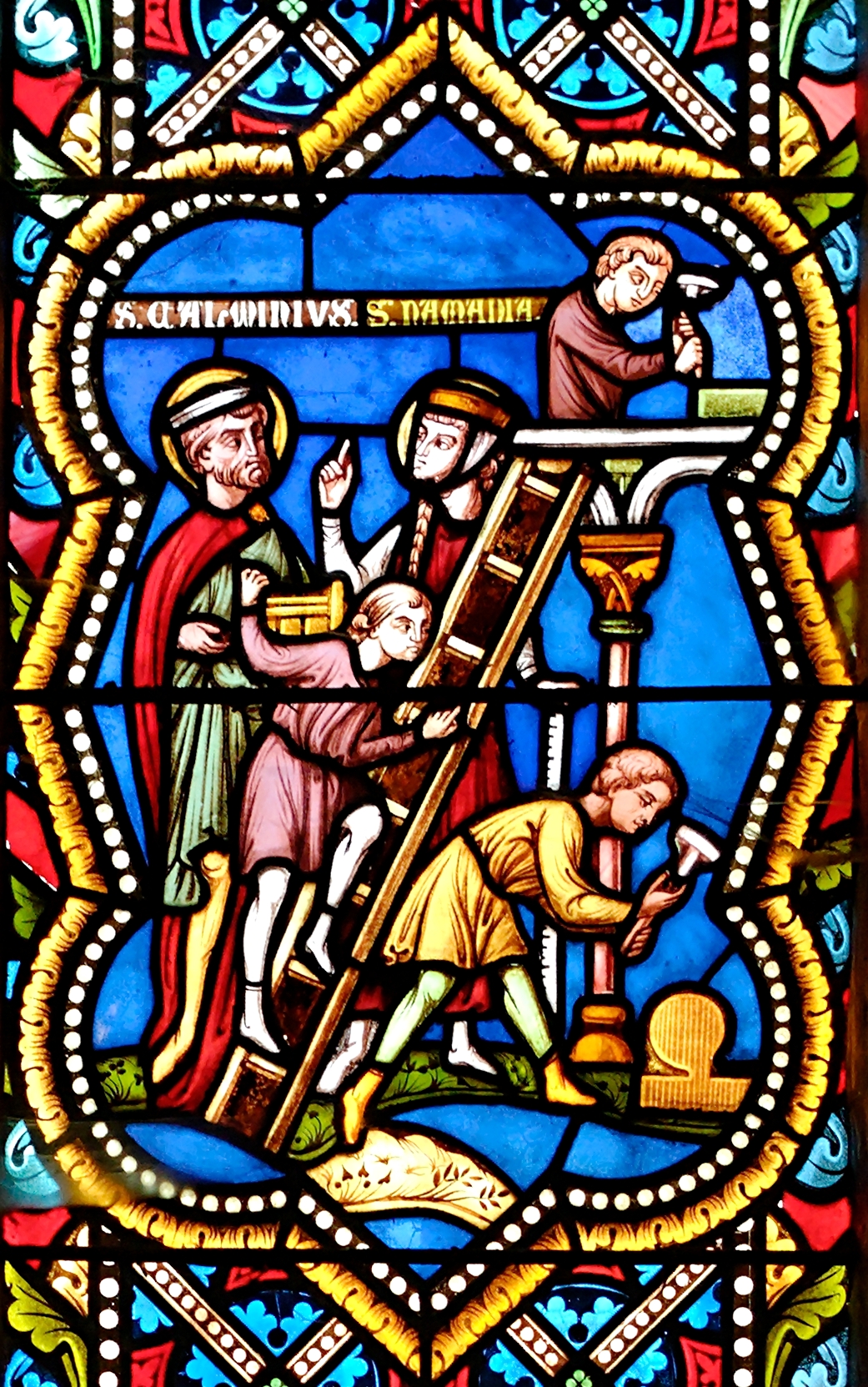
Their Story
Calminius was born into power and violence. As a nobleman of Roman descent in 6th-century France, he inherited titles—Duke of Aquitaine, Count of Auvergne—and the brutal expectations that came with them. His early life was shaped by warfare, political intrigue, and the constant pressure to defend contested lands. He was a man of the sword, not the spirit. But something shifted within him. Perhaps it was exhaustion. Perhaps it was grace. Whatever the catalyst, Calminius faced an agonizing truth: the life of conquest was hollow.
He made a radical choice. He renounced his titles and power, choosing instead the austere path of monastic life—a decision that must have felt like death to his former self. The warrior who once commanded armies now sought solitude in the Velay mountains, building a small oratory where he could pray. This wasn't instant enlightenment; it was messy, difficult rebirth. He struggled through a hermit's existence near Limoges, testing whether he could truly leave his old identity behind.
But Calminius discovered that his warrior's discipline, his ability to organize and lead, didn't disappear—it transformed. He channeled that same fierce determination into building three enduring monasteries: Saint-Chaffre du Monastier, Laguenne Abbey near Tulle, and finally Mozac Abbey in Auvergne, where he chose to spend his final years. By the time he died in the late 7th century, he had created lasting spiritual communities that would outlive empires. The man who once fought for earthly kingdoms had built sanctuaries that would shelter souls for centuries.
Why People Pray to Saint Calminius
Today, people turn to Saint Calminius when facing their own identity crises—when the life they've built no longer feels true. He speaks to anyone trapped between ambition and authenticity, power and purpose. If you're struggling to leave behind a former self, to redirect your talents toward something meaningful, or to believe that radical change is possible no matter how entrenched you are, Calminius offers proof. His feast day, August 19, reminds us that conversion is never too late, and that our greatest strengths can be reborn in service to something sacred.
Lasting Impact
Saint Calminius's three abbeys became intellectual and spiritual centers that shaped medieval French monastic life for centuries. Mozac Abbey, his final foundation, preserved his reliquary and continues to draw pilgrims. His legacy proves that redemption isn't about erasing the past—it's about redirecting power toward healing. The warrior became a builder of sanctuaries.