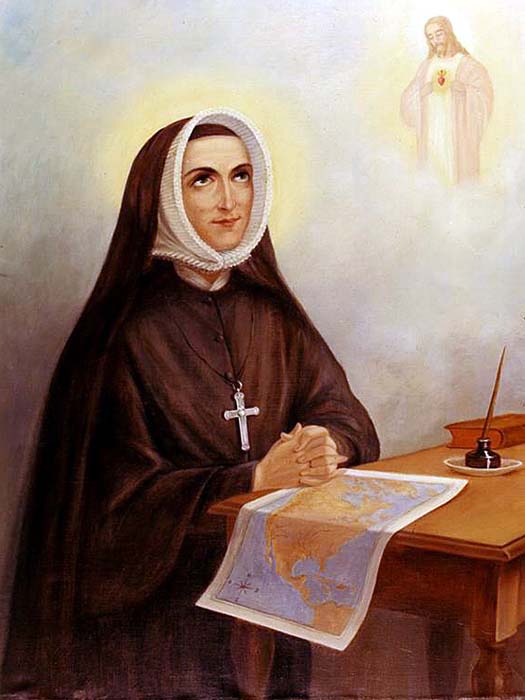
Their Story
Rose Philippine Duchesne grew up in comfort, a merchant's daughter in 1700s France. But privilege bred restlessness. She joined a convent young, hungry for meaning—only to watch the French Revolution shatter it all. Convents were closed. Sisters were scattered. For years, she lived under suspicion, in hiding, watching her vocation dissolve into dust. The ache was real: she had surrendered everything for a calling that seemed extinct.
But Rose refused to let history have the final word. At 49—an age when most would settle into quiet retreat—she boarded a ship to America. She carried broken French and unshakeable faith into the untamed frontier. In Missouri, she learned English, founded schools, and eventually dedicated herself to the Osage and other Indigenous peoples devastated by forced removal. She was no starry-eyed romantic; accounts show she struggled with the rigors of frontier life, the isolation, the language barriers. Yet she persisted. For decades, she taught children who had lost everything, embodying a radical truth: that love doesn't calculate age or convenience.
By her final years, Rose had become something luminous—not because suffering had erased her, but because she had walked through it without bitterness. She died in Missouri at 83, having poured herself entirely into a mission that seemed impossible. The woman who had watched her first calling burn away had quietly built something eternal.
Why People Pray to Rose Philippine Duchesne
People seek Rose Philippine's intercession when facing reinvention—divorce, job loss, forced relocation, the collapse of long-held plans. She teaches that 49 isn't too late to start over, that displacement can become a doorway rather than a dead end. In our age of restlessness and rapid change, she models a different way: grounded commitment, deep listening, and the willingness to learn a completely new language—literal and spiritual—in service of others.
Lasting Impact
Rose Philippine Duchesne pioneered Catholic education in America's heartland and became a voice for Indigenous peoples when few listened. She founded the Society of the Sacred Heart's first U.S. communities, establishing schools that educated thousands. Her legacy endures in the continuing work of her religious congregation and in the principle she lived: that authentic transformation requires vulnerability, courage, and decades of faithful, unglamorous service.
Where Venerated
- the Catholic Church"