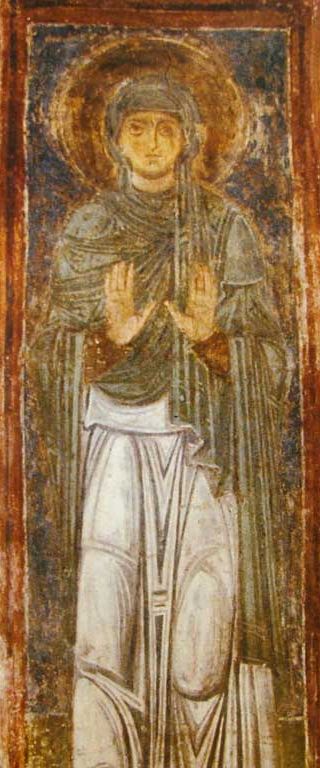
Their Story
Macrina was born into privilege in 4th-century Cappadocia—the eldest daughter of a wealthy, respected Christian family. She had every advantage: education, beauty, prospects for an advantageous marriage. But something gnawed at her. While her younger brothers pursued worldly ambition and theological acclaim, Macrina wrestled with the hollow promise of comfort. She watched her family divide their attention between faith and fortune, and the contradiction became unbearable.
At a critical moment, she made a radical choice: she rejected a prestigious marriage proposal and committed herself to virginity and monastic life. Her family didn't understand. This wasn't rebellion—it was something harder. It was conviction despite love. Macrina built a monastic community with her mother, transforming their family estate into a place of prayer, study, and radical equality. She educated her youngest brother Peter, shaped the spiritual formation of future Church Fathers, and became a spiritual director to theologians and seekers who came to her in confusion.
But her path wasn't serene. She endured illness, witnessed her siblings' struggles, carried the weight of spiritual responsibility. Yet through it all, she remained anchored—not in certainty, but in trust. Macrina's genius was demonstrating that holiness isn't found in escaping the world, but in fully inhabiting your calling with transparency and love. She taught through presence, not proclamation. By the time she died in 379, she had become a living witness to a radical truth: that a consecrated life radiates power precisely because it refuses to compete for power.
Why People Pray to Macrina the Younger
People turn to Macrina when facing crossroads that demand choosing purpose over comfort. She speaks to those wrestling with vocation, doubting whether their calling matters in a competitive world. Educators, spiritual directors, and anyone mentoring younger generations find in her a model of how to shape souls through example rather than authority. She's a saint for the uncertain—those who move forward not because they have all answers, but because they trust the path itself.
Lasting Impact
Macrina reshaped how the early Church understood feminine spiritual leadership. She influenced three Cappadocian Fathers who became pillars of Christian theology, yet she remained behind the scenes—a reminder that transformative power often works through quiet authority. Her monastic model influenced generations of contemplative communities, proving that structured community life could honor both intellectual rigor and mystical depth.