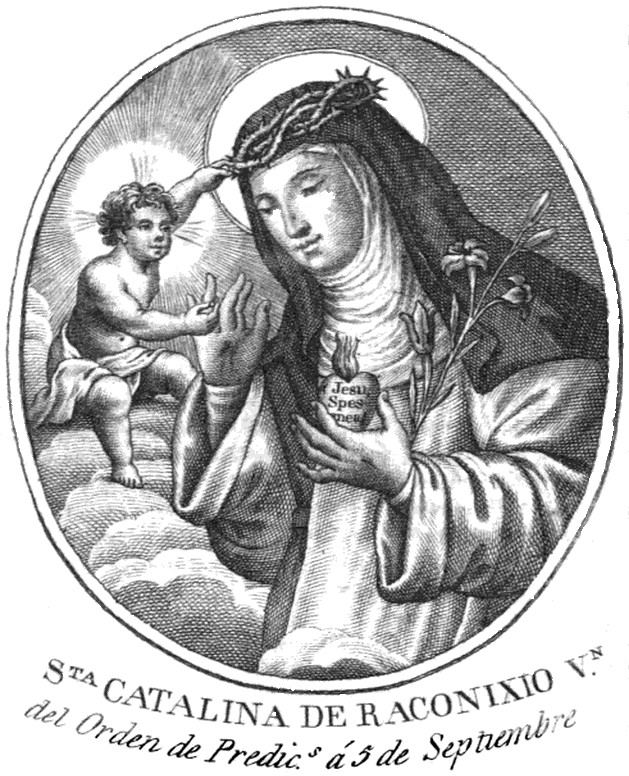
Their Story
Catherine Mattei's childhood was anything but holy. Born in 1486 in Piedmont's poorest corners, she watched her unemployed father sink into despondency and rage while her weaver mother barely kept the family fed. The household was a battlefield of conflict and shame—the kind of environment that breaks children, not sanctifies them. Yet at nine years old, something shifted. A vision arrived: Jesus appeared to her as a boy her own age, and suddenly the heaviness lifted. This wasn't escapism; it was encounter.
But visions alone don't erase poverty or family dysfunction. Catherine continued navigating a world of scarcity and instability, carrying the weight of her father's brokenness. What set her apart was that she didn't harden or become bitter. Instead, she joined the Third Order of Saint Dominic—a community of lay mystics—and devoted herself to prayer, service, and spiritual transformation. Over time, the stigmata appeared: the physical marks of Christ's wounds manifesting on her own body. This wasn't reward for suffering; it was deepening participation in divine compassion.
By her death in 1547 at sixty-one, Catherine had become a living paradox: a woman marked by both poverty and mystical grace, humble yet spiritually radiant. She proved that holiness isn't found in escaping human struggle—it's discovered by walking through it with faith, vulnerability, and an open heart.
Why People Pray to Catherine of Racconigi
Catherine speaks to anyone drowning in family dysfunction or economic hardship who wonders if spiritual transformation is possible for them. She's a saint for those carrying invisible wounds, those abandoned by systems designed to protect them, those asking: 'Can God really meet me here?' People turn to her when pain feels too ordinary for grace, when poverty seems like a barrier to the sacred. Catherine whispers back: your struggle is not a disqualification—it's the exact soil where God plants something miraculous.
Lasting Impact
Catherine of Racconigi expanded the medieval understanding of sainthood by showing that mystical depth could flourish outside convent walls, in ordinary lay life marked by real hardship. Her beatification in 1808 affirmed that spiritual transformation isn't reserved for the privileged or protected—it blooms wherever vulnerability meets faith. She remains a quiet witness to divine presence in forgotten lives.