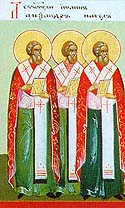
Their Story
Alexander's journey began not in privilege, but in radical vulnerability. Born in distant Calabria, Italy, he was surrendered to monastic life as a child—a renunciation most of us can barely fathom. Yet even within the monastery walls, he struggled. For decades, he pursued increasingly extreme ascetic practices: twenty-day fasts that left him weakened, four years of nakedness enduring the elements and brutal attacks from Saracen raiders. This wasn't spiritual enlightenment—it was spiritual warfare, a man wrestling with his own doubts about whether sacrifice would ever be enough.
But something shifted. Alexander's radical obedience, tested through genuine suffering, became his greatest strength. He traveled Greece with his disciples, teaching not from theory but from lived experience. By 314, at nearly seventy years old, he was appointed vicar to aging Bishop Metrophanes. When Constantinople was renamed in 330—transformed from Byzantium into Constantine's great Christian capital—Alexander became its first bishop. He didn't build an empire through politics; he inherited a city and stewarded it through theological crisis, including the Arian controversy that threatened to splinter the Church itself.
He lived to ninety-six, a witness to Christianity's meteoric rise from persecution to power. His longevity itself was testimony: a man who had endured everything, who had questioned everything, who had survived the desert's cruelty and emerged not hardened but compassionate, became the steady hand Constantinople needed most.
Why People Pray to Alexander of Constantinople
Alexander speaks to anyone navigating radical change or spiritual doubt. In our fractured age, he models how suffering—when offered with intention—transforms us into leaders of wisdom rather than authority. People pray to him when facing overwhelming responsibility, when doubting whether their sacrifices matter, when building something meaningful from chaos. His feast day reminds us that endurance isn't passive resignation; it's active transformation.
Lasting Impact
Alexander established Constantinople as a spiritual center and shepherded it through doctrinal crisis. His tenure set precedent for the Ecumenical Patriarch's role as guardian of Orthodox Christianity. He proved that longevity and humility, not political maneuvering, create lasting institutional strength. His legacy endures wherever spiritual leadership prioritizes compassion over conquest.