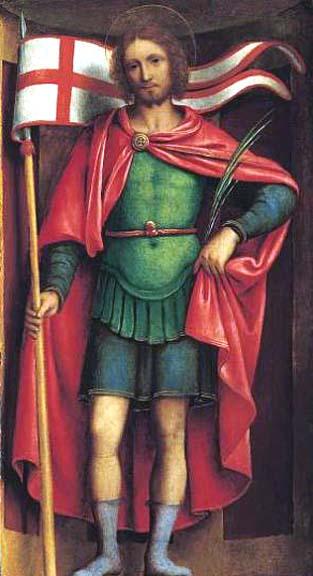
Their Story
Alexander of Bergamo lived in a world of brutal contradiction. A military officer in the Roman army—respected, positioned, secure—he carried the vexillum (standard) for the Theban Legion, a unit of elite soldiers. By all measures, he had succeeded. He'd climbed the ranks, earned authority, belonged to power.
But something had fractured in him. Somewhere along the way, his private faith became irreconcilable with his public role. By 303 AD, Emperor Diocletian's persecution of Christians wasn't abstract doctrine—it was an order with his name on it. Renounce Christ, or face the consequences. The choice seemed simple to everyone else. Apostasy or death. One word could save his life.
Alexander couldn't speak it. Not because he was fearless—the sources suggest he wrestled with this decision—but because the man he'd become internally couldn't betray the man he'd become spiritually. He refused to perform the pagan sacrifices demanded of soldiers. He refused to persecute the Christians in Bergamo. And when the final demand came, he refused to recant.
On August 26, 303, he was tortured and executed in Bergamo, dying as a martyr rather than living as a compromised man. His body became a relic; his choice became a legend. Centuries later, Bergamo itself would claim him as patron—not despite his refusal, but because of it. The man who had everything and lost it all became the city's spiritual anchor, a reminder that some things cannot be negotiated away.
Why People Pray to Alexander of Bergamo
Today, Alexander speaks to anyone standing at the intersection of conviction and consequence. In workplaces, families, and communities, people face quiet versions of his ancient choice: compromise what you believe, or accept the cost of integrity. Alexander's intercession steadies those who refuse to perform false allegiance. He's the patron of professionals struggling with ethics, of minorities asked to disappear themselves, of anyone whose conscience demands they say no—even when saying yes would be easier. His feast day reminds us that some refusals are sacred.
Lasting Impact
Alexander of Bergamo transformed a moment of defiance into centuries of spiritual authority. Venerated by both Roman Catholic and Eastern Orthodox churches, his relics rest in Italy as a testament to principled resistance. He became the patron saint of multiple Italian communes, his name synonymous with unwavering conscience. More than a martyr, he's a mirror: proof that integrity outlasts empires.