Their Story
Tiburtius was born into privilege and fear. His father, Chromatius, was prefect of Rome—a man who ordered Christians to their deaths. Young Tiburtius watched his father's cruelty, caught between filial duty and a growing conviction that something was profoundly wrong. When Sebastian, a soldier-turned-spiritual guide, befriended him, Tiburtius glimpsed another path. But choosing it meant betraying everything his father represented, rejecting the security of Rome's highest circles, and hiding like a fugitive in his own home.
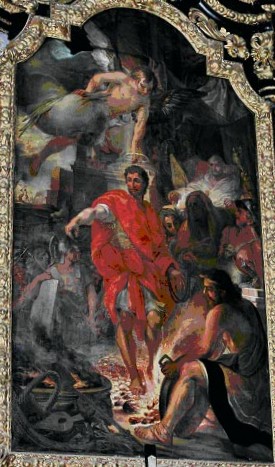
For years, Tiburtius lived in the shadows of his father's palace during Diocletian's brutal persecution. A traitor exposed him. Dragged before the prefect Fabianus, Tiburtius faced an impossible choice: recant and live, or confess and die. He confessed. Authorities demanded proof that his faith was genuine, not delusion. So Tiburtius did something unthinkable—he walked barefoot across red-hot coals, the sign of the cross his only protection. His feet remained unmarred. The miracle was undeniable, yet the authorities called it sorcery. They couldn't accept that faith itself was the real power.
On the Via Labicana, near two laurel trees, Tiburtius was beheaded in 286 AD. He was young, unknown to history, yet his name endured in Pope Damasus I's epigrams. What made him unforgettable wasn't his privilege—it was his willingness to surrender it. He showed that true courage isn't the absence of fear; it's walking through fire anyway.
Why People Pray to Tiburtius and Chromatius
People turn to Tiburtius when facing impossible choices between loyalty and conscience, between comfort and truth. He intercedes for those caught between two worlds—family expectations and personal conviction, security and integrity. In our age of compromised values and institutional pressure to conform, Tiburtius reminds us that some fires are worth walking through. He strengthens the resolve of whistleblowers, reformers, and anyone choosing authenticity over approval.
Lasting Impact
Tiburtius became a symbol of martyrdom not through seeking death, but through refusing to deny truth. His feast day (August 11) keeps his witness alive across Catholic, Orthodox, and Oriental Christian traditions. He teaches that even the young, even those born into power, can become agents of transformation through radical honesty.