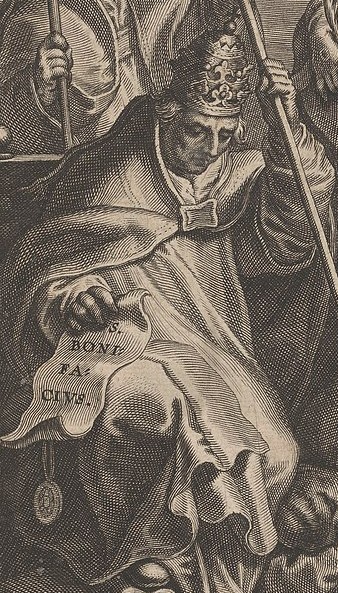
Their Story
Pope Boniface I entered history under a shadow. When the papal election of 418 occurred, Rome fractured. His rival, Antipope Eulalius, commanded fierce support among the Roman clergy and people. Boniface was left as the contested figure—questioned, doubted, his legitimacy hanging in the balance. Many wondered if he possessed the authority to lead. For months, the Church remained torn, with two men claiming the papal throne. The uncertainty gnawed at Rome's spiritual foundation.
Yet Boniface refused to retreat into bitterness or despair. Instead, he embodied quiet persistence. He appealed to Emperor Honorius, trusting not in political maneuvering but in the clarity of his vocation. When the Emperor finally settled the dispute in Boniface's favor, he didn't gloat—he worked. During his four-year papacy (418-422), he focused on what mattered most: restoring Church discipline, defending ecclesiastical authority against encroaching imperial power, and reinvigorating the metropolitan sees of Narbonne and Vienne that had been weakened by neglect.
Boniface's real struggle wasn't winning an election—it was proving that authentic leadership transcends the noise of competing claims. In a Church fractured by ambition, he modeled something radical: fidelity to duty over hunger for validation. He walked the razor's edge between firmness and compassion, between defending the Church's independence and respecting legitimate secular authority. His brief papacy became a testament to how one person, lacking fanfare but possessed of unwavering conviction, can stabilize a community at its most vulnerable moment.
Why People Pray to Pope Boniface I
In an age of institutional distrust and competing authorities, Boniface I speaks to those navigating contested territory—whether in faith, work, or relationships. People turn to him when their legitimacy is questioned, when they stand alone against opposition, or when they must lead without obvious validation. He teaches that true authority emerges not from winning arguments, but from faithful action amid doubt. Boniface intercedes for those called to difficult positions, reminding them that integrity—not victory—is the measure of a life well-lived.
Lasting Impact
Pope Boniface I preserved papal independence during Rome's political turbulence and established crucial precedents for ecclesiastical governance. Though his papacy lasted only four years, his steadfast navigation of the disputed election set a template for resolving future Church conflicts through principled diplomacy. He strengthened diocesan authority and restored neglected regions to vitality—demonstrating that spiritual leadership thrives not through power-seeking, but through patient restoration and institutional renewal.