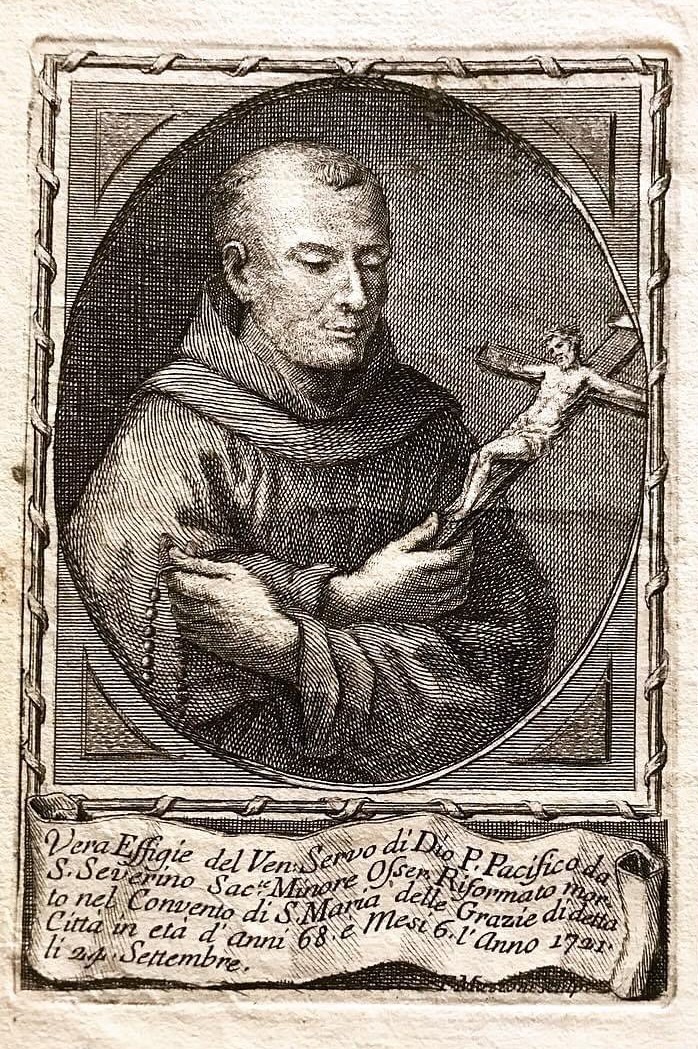
Their Story
Carlo Antonio Divini entered the world as the youngest of thirteen children, only to lose both parents before he could form a single memory of them. Raised by his uncle, the archdeacon Luzizio Bruni, Carlo faced a childhood of emotional distance—a strict guardian's hand replacing a mother's warmth. The boy carried an invisible wound: the ache of abandonment, the uncertainty of belonging, the loneliness that comes from being the overlooked youngest in a noble household.
As a young man, Carlo wrestled with these early scars. But something shifted when he encountered the Franciscan order. Here, among brothers devoted to healing and service, he found what his childhood lacked: genuine community. He took the name Pacificus—the peacemaker—not because peace came easily, but because he had learned it through struggle. His transformation was gradual, hard-won. The orphaned boy who once felt forgotten became a priest whose presence brought comfort to the dying, whose prayers allegedly sparked miracles, whose hands touched those society had abandoned.
For sixty-eight years, Pacificus lived in San Severino, channeling his early pain into radical compassion. He became known as a miracle-worker not through supernatural power, but through the most human of gifts: he saw suffering because he had suffered. He offered hope to the hopeless because he had once been hopeless himself. When he died in 1721, the people of San Severino mourned a man who had transformed personal tragedy into collective healing.
Why People Pray to Pacificus of San Severino
People turn to Pacificus today when carrying the weight of early loss—abandonment, parental absence, or childhood isolation. In a world that rushes past trauma, he reminds us that our deepest wounds can become our greatest sources of compassion. Those working in healing professions—counselors, nurses, social workers—find in him a patron who understands both darkness and redemption. He teaches us that loneliness can become connection, and that our pain, when offered with love, becomes medicine for others.
Lasting Impact
Canonized in 1839, Pacificus remains the patron saint of San Severino Marche, a living reminder that holiness is not the absence of suffering but its redemption. His feast day on September 24th honors not a distant, perfect figure, but a man who transformed personal tragedy into a lifetime of service—proving that our scars can become doorways to healing others.