Their Story
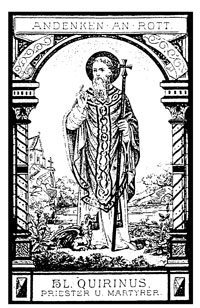
History barely remembers them. Four names—Nicasius, Quirinus, Scubiculus, and Pientia—attached to a mission that may never have happened, in a time when certainty crumbled like ancient parchment. These were ordinary people called to an extraordinary task: sent from Rome to evangelize Gaul in an era of pagan resistance and political chaos. Quirinus served as priest, Scubiculus as deacon, Nicasius possibly a regionary bishop. But what drove them into the unknown? Fear must have gripped them. The roads were treacherous, the people hostile, their message radical. One legend speaks of Quirinus confronting a dragon at Vaux-sur-Seine—a creature that had poisoned wells and terrorized villages. Whether literal or symbolic, it captures their true struggle: battling the spiritual darkness that consumed their world.
Their mission ended in violence. Imprisoned by Domitian's soldiers, they faced beheading in the Vexin region around 285 AD. Here is where legend transcends history: the accounts describe them as cephalophores—the beheaded saints who picked up their own heads and walked to an island on the Epte River, where a woman named Pientia buried them alongside a priest named Clarus. Their bodies rest at Malmedy Abbey, a shrine that emerged from mystery and devotion. What matters is not whether every detail is factual, but what their story reveals: that faith transforms obscurity into immortality, that those forgotten by history are remembered by heaven, and that courage persists even when records fade into legend.
Why People Pray to Nicasius, Quirinus, Scubiculus, and Pientia
In our age of doubt and historical skepticism, these saints teach us that faith thrives in mystery. People turn to them when facing unclear paths, when institutional certainty crumbles, when they must act despite incomplete information. They're patrons for missionaries, travelers, and anyone venturing into hostile terrain—spiritual or physical. Their uncertain historicity paradoxically strengthens their witness: they prove that dedication matters more than documentation, and that love transcends the boundaries between legend and truth.
Lasting Impact
Though their historical reality remains disputed, Nicasius, Quirinus, Scubiculus, and Pientia left an indelible mark on European spirituality. Malmedy Abbey became a pilgrimage destination, their feast day observed on October 11th. They represent the countless unnamed evangelists whose names were lost but whose faith shaped Christendom. Their ambiguous legacy invites us to honor those whose stories we'll never fully know.