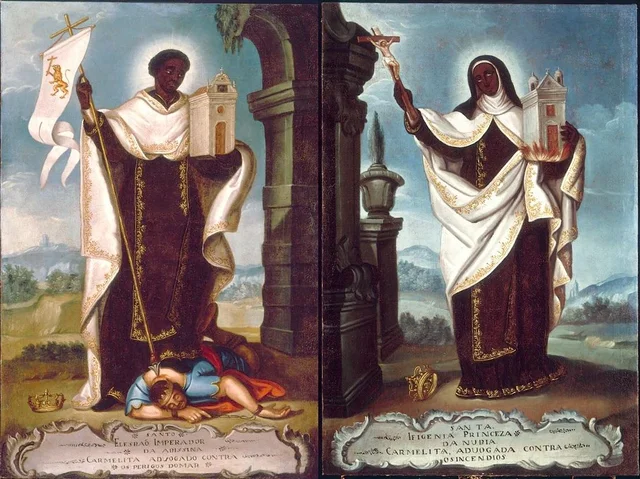
Their Story
Kaleb inherited a throne in 514 CE and immediately faced the weight of empire. As King of Axum, one of the ancient world's four superpowers, he ruled with military authority over sprawling territories. Yet power alone left him searching. The complexities of governing a vast kingdom stretched across Ethiopia and Eritrea demanded endless political calculations, military decisions, and the burden of holding together a civilization through sheer force of will.
But something shifted within him. Kaleb's reign became marked not by conquest, but by conviction. He transformed his kingly authority into spiritual leadership, becoming a champion of Christian faith when it was still dangerous and countercultural. Rather than clinging to temporal power, he gradually redirected his empire's resources toward religious devotion and the protection of Christian communities. This wasn't a sudden conversion—it was a radical reorientation of his entire purpose.
By the end of his reign (542 CE), Kaleb had become known as Saint Elesbaan across Orthodox, Eastern, and Catholic traditions. He chose to step back from absolute rule, demonstrating that true sovereignty meant serving something greater than oneself. His journey reveals a profound truth: the most powerful transformation isn't denying who we are, but redirecting our strength toward what matters eternally.
Why People Pray to Kaleb of Axum
People turn to Kaleb today when wrestling with ambition and purpose. In a world obsessed with accumulating power and status, his example speaks powerfully to those asking: *Is this all there is?* Leaders, executives, and anyone struggling to reconcile worldly success with spiritual hunger find in him a mirror and a mentor. He teaches us that true greatness lies not in what we possess, but in what we're willing to surrender.
Lasting Impact
Kaleb's reign marked a pivotal moment when one of history's greatest empires aligned itself with Christian faith. Venerated across Oriental Orthodox, Eastern Orthodox, and Roman Catholic traditions, his feast days span three continents and centuries. He proved that kingdoms built on conviction outlast those built on conquest alone, influencing how rulers understood the relationship between political power and spiritual responsibility.