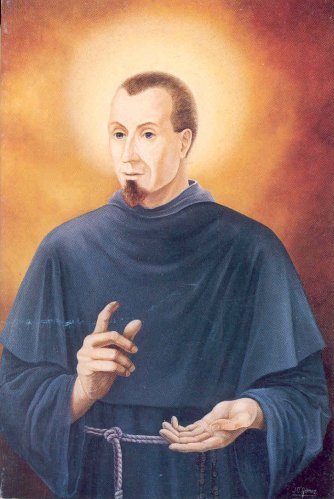
Their Story
Born Giovanniello Fasani in 1681 in Lucera, a dusty corner of the Kingdom of Naples, Francis entered the Franciscan order young—seeking refuge in religious life rather than running toward a calling. The early years were consumed by study and internal discipline, the quiet struggle of a man learning to surrender his will to something larger. He professed his vows in 1696, but the real battle was invisible: wrestling with whether his faith could matter beyond monastery walls, whether prayer alone could heal the suffering he witnessed in his hometown.
Then something shifted. As pastor of Lucera, Francis made a radical choice. He stopped hiding behind ritual. For nearly forty years, he became a fixture in the streets—his voice raw from preaching, his hands calloused from serving prisoners, orphans, and the destitute. People called him fervent, not because he was loud, but because his devotion to Mary Immaculate and his practical mercy were indistinguishable. He didn't theorize about poverty; he lived among it. He didn't preach forgiveness in abstract terms; he sat with the incarcerated. His great work was simple: he made the invisible visible. By the time he died on November 29, 1742, Francis had proven that holiness isn't about escaping the world—it's about entering it completely, with both eyes open.
Why People Pray to Francis Fasani
In our age of scrolling past suffering, Francis reminds us that compassion demands presence. People pray to him when they feel helpless before injustice, when they work with the marginalized, or when they struggle to align their faith with action. He intercedes for those serving prisoners, caring for orphans, and advocating for the poor—showing that spiritual life and social justice are not separate, but one continuous act of love.
Lasting Impact
Francis Fasani canonized in 1986, stands as Lucera's patron saint—a symbol that holiness germinates in forgotten places through relentless, humble service. His forty-year commitment to the poorest established a model: faith proves itself not in temples but in streets, not in words but in presence. He remains the saint of those who refuse to turn away.
Where Venerated
- the Franciscan Order on 29 November