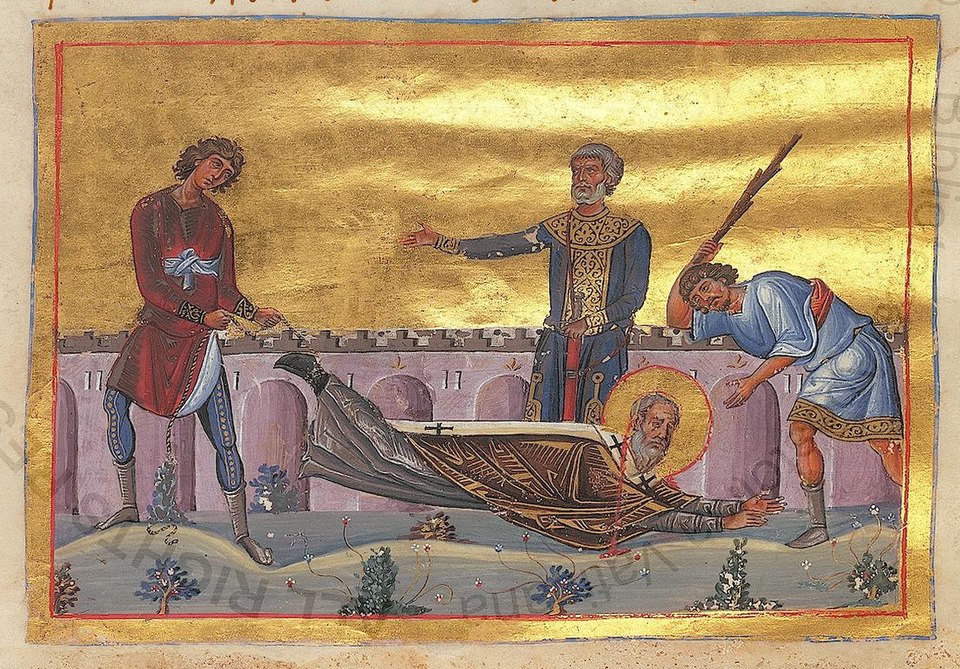
Their Story
Dorotheus began as a brilliant priest of Antioch, a learned man who devoted himself to understanding sacred texts and Christian history. Yet his intellect alone couldn't shield him from the terror that gripped the Church during Diocletian's brutal persecution. Like countless Christians of his time, he faced an agonizing choice: renounce his faith or lose everything. He was driven into exile, torn from his community, forced to live as a fugitive. The fear must have been suffocating—not just for himself, but for the faith itself, which seemed to be collapsing under imperial violence.
But Dorotheus refused to break. He survived that first wave of persecution and returned to serve as bishop of Tyre, eventually attending the Council of Nicaea in 325—a pivotal moment when the Church was defining itself against heresy. Yet even as the persecutions eased, new dangers emerged. When Julian the Apostate rose to power decades later, determined to crush Christianity, Dorotheus faced exile once more. This time, he was sent to the frozen shores of Odyssopolis on the Black Sea.
What makes Dorotheus extraordinary is not that he suffered—many did. It's that at 107 years old, after a lifetime of displacement and danger, he remained so utterly committed to his faith that he was martyred rather than compromise. He didn't become holy by escaping struggle; he became holy by walking through it, again and again, refusing to let fear calcify his heart. His longevity itself became a testimony—a living proof that faith could sustain a human being through decades of upheaval.
Why People Pray to Dorotheus of Tyre
People turn to Dorotheus when facing relentless pressure to abandon their convictions—whether from persecution, cultural opposition, or doubt. He intercedes for those in exile, both literal and spiritual; for scholars and seekers struggling to hold faith and reason together; and for the elderly facing mortality without losing purpose. In our age of constant upheaval, Dorotheus reminds us that endurance itself is sacred, and that showing up faithfully, again and again, is how we transform the world.
Lasting Impact
Dorotheus left behind not monuments but testimony—his Acts of the Seventy Apostles preserves early Christian history and links us to the apostolic age. His life models a radical faithfulness that transcends any single era. For nearly 1,700 years, Christians have honored him as proof that holiness means persistence, not perfection; that a human being can remain unbroken even when exiled, even when ancient, even when the world seems determined to erase them.