Their Story
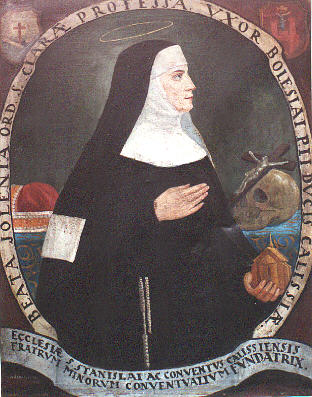
Yolanda's story begins not in a monastery, but in a marriage she didn't choose. Sent from Hungary to Poland as a young girl to be tutored by her sister Kinga, she was soon arranged to wed Bolesław the Pious in 1257. Royal life meant political duty, three daughters, and the constant pressure to secure dynastic alliances—not freedom to pursue her spiritual calling. For two decades, she walked this narrow path: dutiful wife, devoted mother, powerful noblewoman. Yet something deeper stirred within her.
When Bolesław died in 1279, everything changed. Widowhood in medieval Europe meant vulnerability, yet for Yolanda it became liberation. While she could have remarried to preserve her status, she chose differently. The woman who once navigated court politics now gave herself entirely to the voiceless—the poor, the sick, the forgotten. She didn't just donate money; she rebuilt monasteries, friaries, and hospitals with her own hands alongside the workers. She walked among lepers and beggars when nobility hid behind palace walls. Her late husband had earned the nickname 'the Pious' because he supported her vision; now, alone, she became the living embodiment of what charity actually means.
Yolanda retreated to Gniezno, becoming an abbess and spiritual guide. The woman born to command thrones chose instead to serve the least among her people. Her transformation wasn't a dramatic conversion moment—it was a woman finally permitted by circumstance to become who she'd always believed she should be. By the time she died in 1298, she'd reshaped not just individual lives, but Poland's spiritual landscape.
Why People Pray to Blessed Yolanda of Poland
In an age of burnout and purposeless success, Yolanda speaks to those who feel trapped by expectations—whether professional, familial, or social. People pray to her when grief feels unmanageable, when loss threatens to define them. She teaches us that the most devastating life events can become gateways to authentic meaning. Those working in social justice, nonprofit leadership, or direct service find her especially powerful: she shows that true transformation requires not just intention, but sacrifice—and that vulnerability often precedes impact.
Lasting Impact
Yolanda's legacy reshaped medieval Poland's spiritual infrastructure. She proved that royal privilege, when surrendered to service, creates lasting change. Her daughters married into Polish nobility, spreading her values forward; her spiritual descendants—the communities she nurtured—continued her work centuries after her death. Canonized in 1827, she remains the patron of those seeking purpose beyond power.