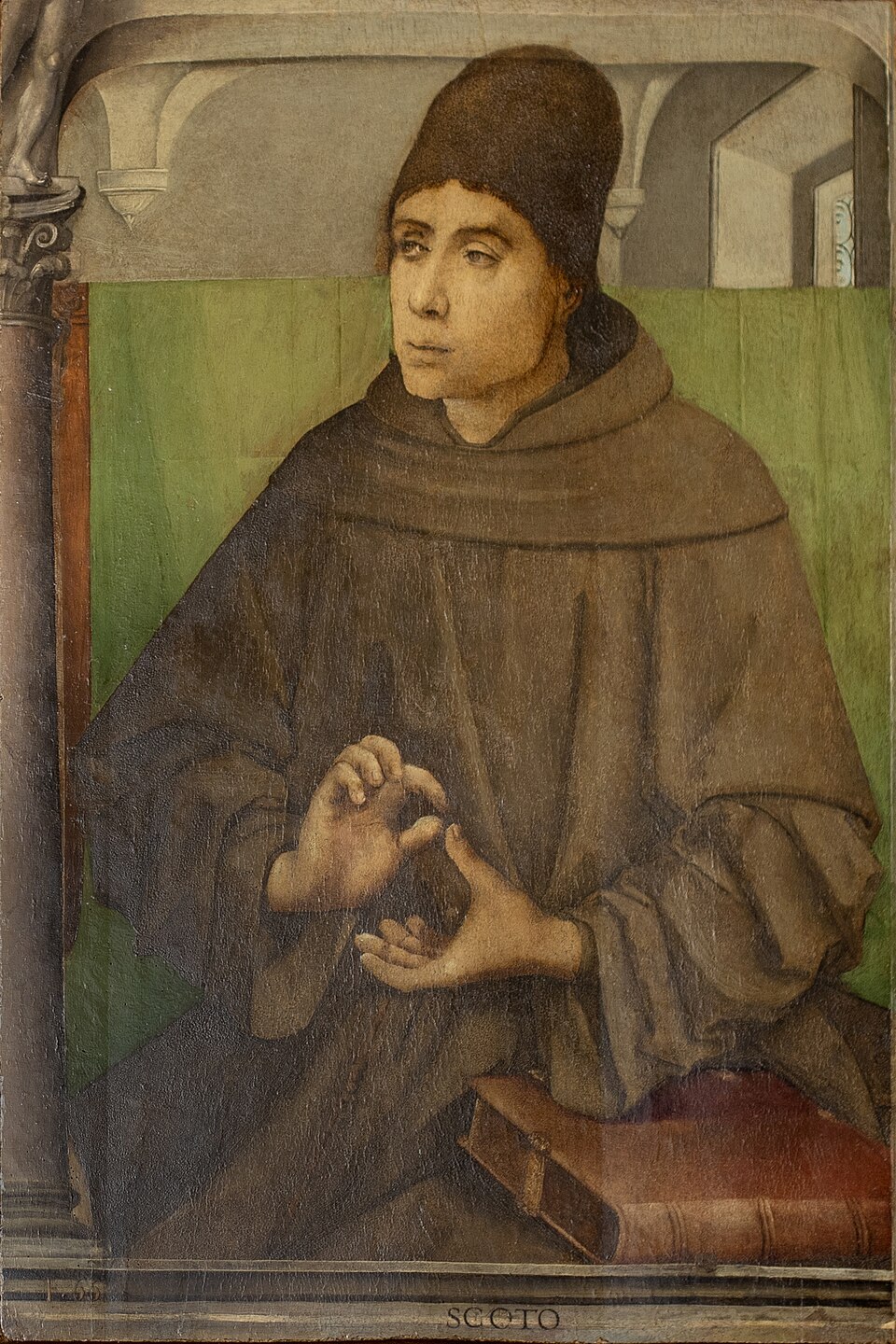
Their Story
John Duns was born into uncertainty—a Scottish boy in a fractured kingdom, bearing a name that would later become synonymous with mockery. He entered the Franciscan order seeking clarity, but found instead endless questions. While other scholars accepted the prevailing theological consensus, young John couldn't rest. He studied at Oxford and Paris, wrestling with contradictions that others overlooked, his restless mind both a gift and a burden. His peers found him difficult—too questioning, too willing to challenge authority, too stubborn in debate. For years, he lived in intellectual isolation, convinced his radical ideas about human free will and divine love were dangerous heresies.
But something shifted. John realized his doubt wasn't a failure—it was an invitation. He began teaching that God's love was not bound by logic or philosophy, but moved by pure will and boundless mercy. This radical compassion became his breakthrough. He developed "Scotism," a philosophical revolution that honored both reason and mystery, that insisted every person mattered because God chose them freely, not out of necessity. His work spread across Europe, influencing theologians for centuries. By his death in Cologne at just 42, the man once dismissed as a troublemaker had become "the Subtle Doctor"—the teacher who proved that intellectual honesty and spiritual depth could dance together.
John's life teaches us: your questions aren't your weakness. Your struggle to understand complexity, your refusal to accept easy answers—these are invitations to discover truths others miss.
Why People Pray to Blessed John Duns Scotus
Students and scholars invoke Duns Scotus when drowning in doubt—when their questions feel too big, their minds too restless. Academics pray to him during intellectual crises, when the pressure to conform wars against the call to think deeply. He's the patron of those who've been called "difficult" or "too much," who sense their intense questioning is actually a spiritual gift. In our age of soundbite answers, John reminds us that rigorous thinking and genuine faith aren't enemies—they're lovers.
Lasting Impact
Duns Scotus revolutionized medieval philosophy by championing human freedom and divine love as central to theology. His influence shaped Catholic thought for 700 years. Today, he stands as proof that the person who asks hard questions, who refuses simplistic answers, who thinks differently—can become a beacon for generations. His legacy: never apologize for your mind.
Where Venerated
- the late fifteenth century