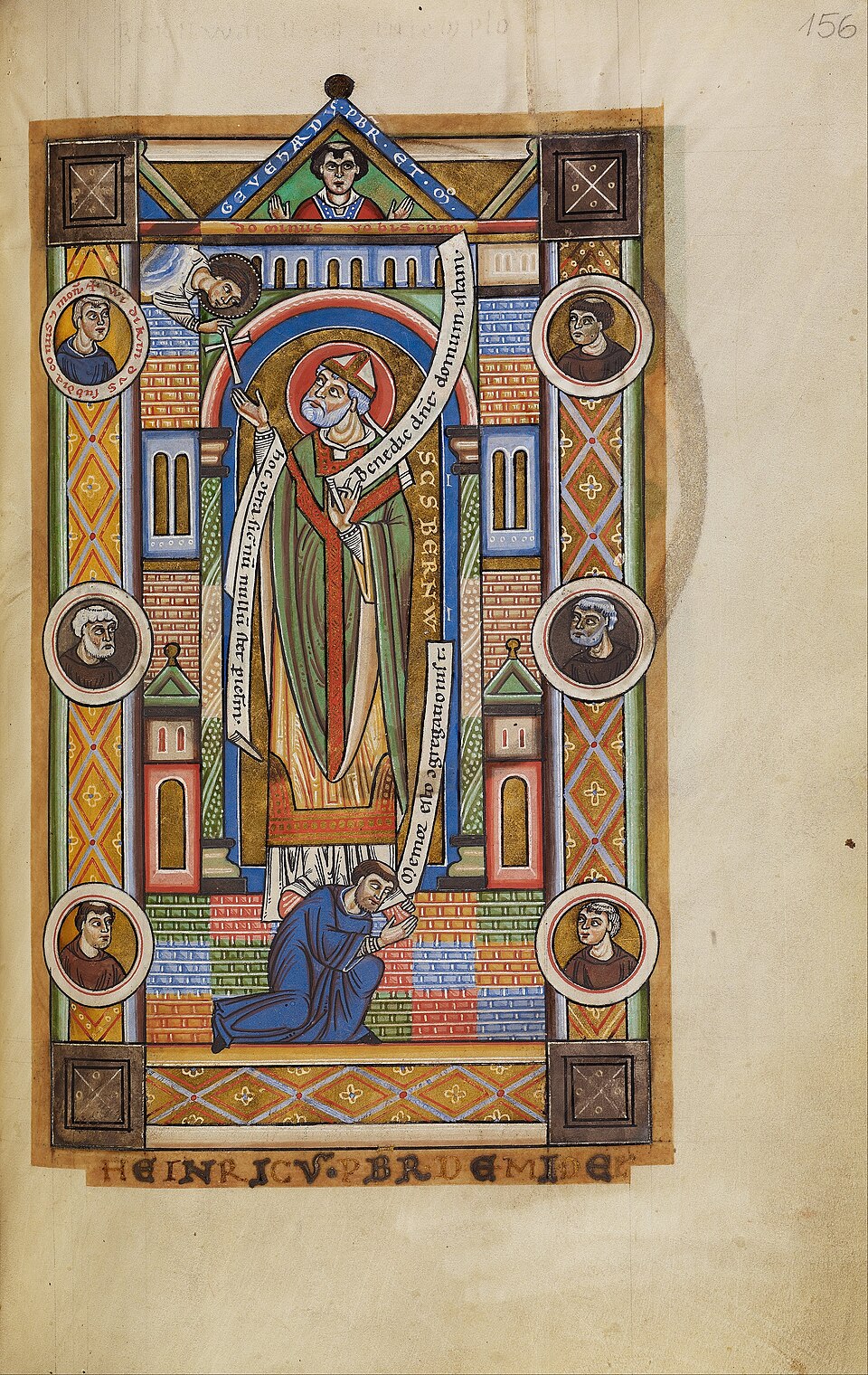
Their Story
Bernward's childhood was marked by loss. Orphaned early, he was handed from guardian to guardian—first to his uncle, the Bishop of Utrecht, then to a rigorous tutor at Heidelberg. He was groomed for greatness, but greatness felt hollow. As a young scholar, he mastered theology, mathematics, and the liberal arts, yet something gnawed at him: knowledge alone couldn't heal the emptiness left by his parents' absence.
When offered prestigious positions within the Church's hierarchy, Bernward made a surprising choice. He turned them down to care for his aging grandfather—a quiet act of love that revealed his true compass. After his grandfather's death, he became tutor to the young Otto III at the imperial court, shaping the future Holy Roman Emperor. But even this honor felt incomplete.
Everything shifted when Bernward became Bishop of Hildesheim in 993. Here, he discovered his calling: not in wielding ecclesiastical power, but in creating. He became a craftsman-bishop, designing and forging bronze doors, building churches, commissioning sacred art. His hands shaped metal and stone; his vision transformed entire communities. For nearly thirty years, he lived a paradox—a nobleman who spent his nights in prayer and his days laboring like an artisan. When he died on November 20, 1022, Hildesheim had been remade by his creative grace. He had learned that the deepest power comes not from position, but from pouring oneself into beauty that outlasts us.
Why People Pray to Bernward of Hildesheim
Artists, architects, craftspeople, and anyone struggling with their calling turn to Bernward today. He teaches us that creative work is spiritual work—that the hands matter as much as the mind. Those caught between worldly ambition and authentic calling find in him a patron who chose integrity over advancement. He reminds us that leaving a legacy isn't about climbing higher; it's about building something that endures.
Lasting Impact
Bernward transformed Hildesheim into a center of medieval art and architecture. His bronze doors at St. Mary's Cathedral remain masterpieces of Romanesque craftsmanship, telling biblical stories through metal. He is venerated as the patron of architects, painters, sculptors, and goldsmiths—a saint who proved that holiness and handiwork are inseparable.