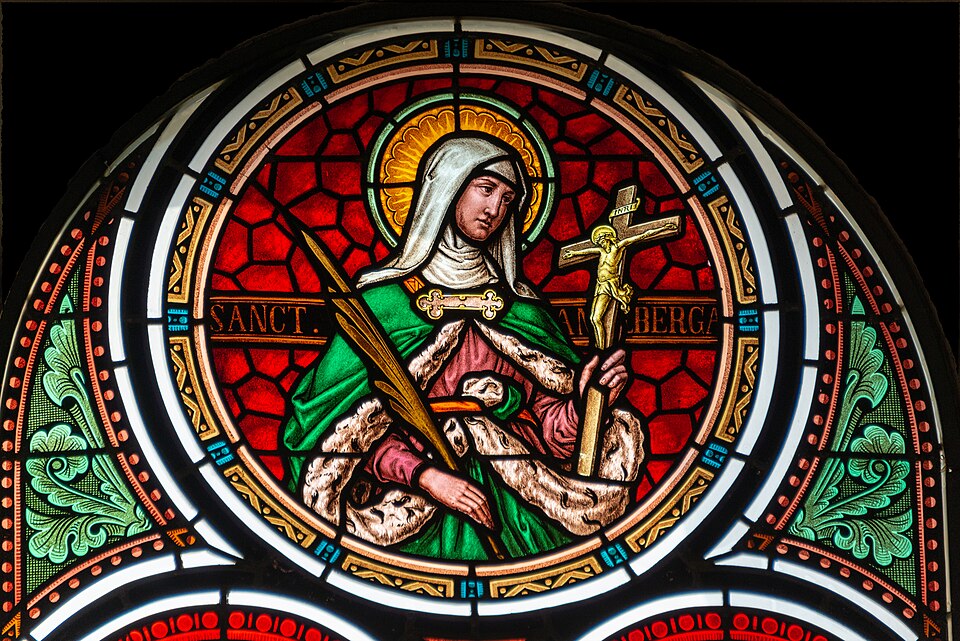
Their Story
Amalberga's story began not with divine calling but with powerlessness. Born into Brabant nobility in the 7th century, she had little say in her own life. Her powerful uncle Pepin of Landen—a ruthless political operator—married her off against her will to a great lord named Thierry. This wasn't romance; it was strategy. She bore his daughter, Pharailda, watching her own dreams shrink into the narrow duties of a noblewoman. When Thierry died, she might have hoped for peace. Instead, Pepin forced her into a second marriage to Count Witger, Duke of Lorraine, a man of considerable power and ambition.
For years, Amalberga lived a fractured life—a dutiful wife and mother who had never been asked what she wanted. She gave birth to five children who would themselves become saints, raising them in a world where her voice mattered only in the domestic sphere. But somewhere in the raising of those children, in the quiet witness of her faithfulness to impossible circumstances, something shifted. When Witger reached middle age, he felt called to religious life and entered the Benedictine monastery at Lobbes. This moment—her husband leaving—became Amalberga's liberation. She didn't follow him into silent widowhood. Instead, she joined the Benedictine nuns at Maubeuge, finally choosing her own path.
At last, Amalberga discovered agency. In the convent, she transformed from an obedient vessel into a woman of genuine spiritual authority. Her life became her own. She died around 690, her remains eventually enshrined at Binche, a testament to a woman who endured the powerlessness of her era and ultimately claimed her own destiny.
Why People Pray to Amalberga of Maubeuge
Today, people turn to Amalberga in moments of enforced obligation and lost agency. She understands the ache of doing what's expected when it costs you your selfhood. Women especially find in her a patron who knows the weight of duty without choice, yet models that surrender can coexist with eventual freedom. She's also invoked for physical suffering—arm pain, bruises, fever—but her deeper gift is healing the wounds inflicted by a life not freely chosen.
Lasting Impact
Amalberga's legacy lies in her silent revolution: she showed that holiness doesn't require compliance with others' plans. Five of her children became saints, spreading her spiritual bloodline across generations. Her shrine at Binche became a pilgrimage destination, where the dispossessed found hope that even constrained lives can birth unexpected grace.